 by
by 
Marbella PGOM 2026 – Marbella Approves New PGOM: What Changes Under the LISTA in 2026
Marbella PGOM 2026 – Marbella Approves the First PGOM in Andalusia Adapted to the LISTA
Marbella approved its new Plan General de Ordenación Municipal (PGOM) on 18 September 2026, replacing the general planning framework dating from 1986 and becoming the first municipality in Andalusia to approve a PGOM adapted to the LISTA.
The plan recognises more than 53 million m² of urban land, compared with approximately 40 million m² under the previous framework, while the POU will establish more detailed planning parameters.
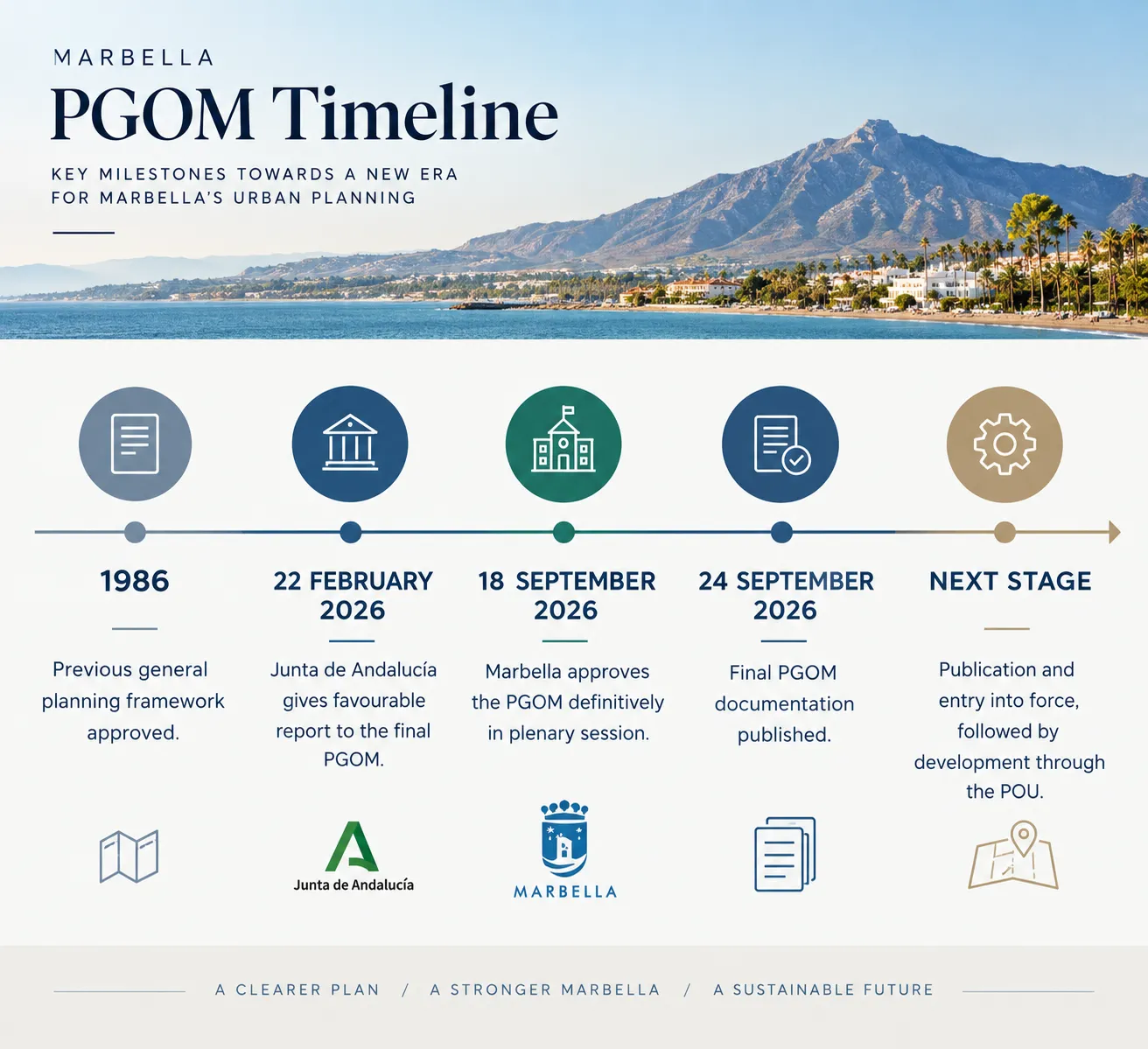
What is the new Marbella PGOM 2026?
- PGOM = Plan General de Ordenación Municipal
- It establishes the municipality’s general territorial and urban-planning framework.
- It replaces the general planning determinations of the 1986 framework.
- It has been adapted to the Andalusian LISTA.
- In Andalusia, the LISTA refers to the Law for the Promotion of Territorial Sustainability in Andalusia (Law 7/2021).
- It is not the same instrument as the POU.
- POU = Plan Ordenacion Urbana. An Urban Planning Scheme (POU) is an instrument of detailed urban planning.
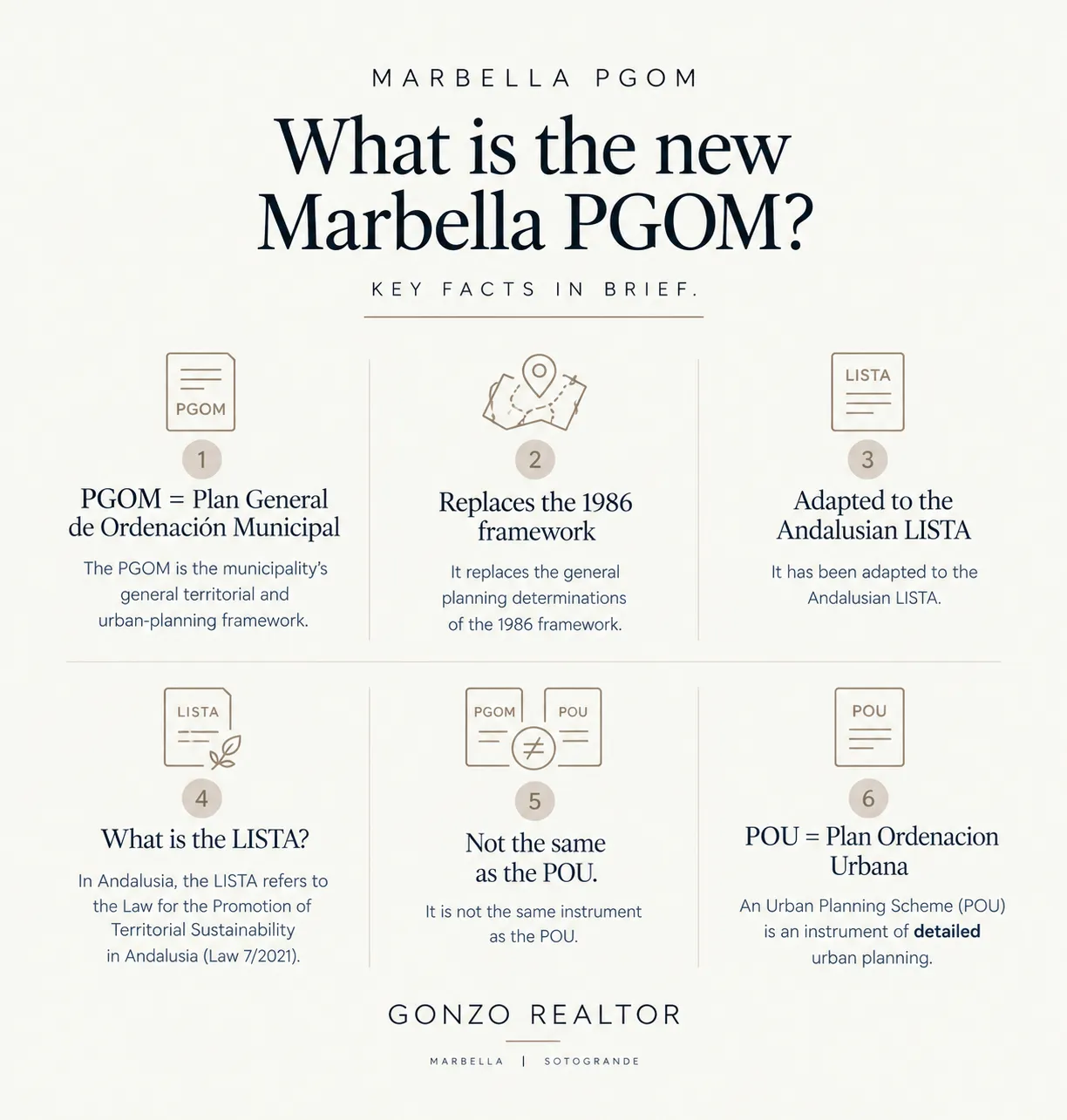
When was Marbella’s PGOM approved?
| Date | Milestone |
|---|---|
| 1986 | Previous general planning framework approved |
| 22 February 2026 | Junta de Andalucía gives favourable report to the final PGOM |
| 18 September 2026 | Marbella approves the PGOM definitively in plenary session |
| 24 September 2026 | Final PGOM documentation published |
| Next stage | Publication and entry into force, followed by development through the POU |
The Junta’s favourable report was issued in February 2026 and explicitly described the plan as replacing the 1986 PGOU.
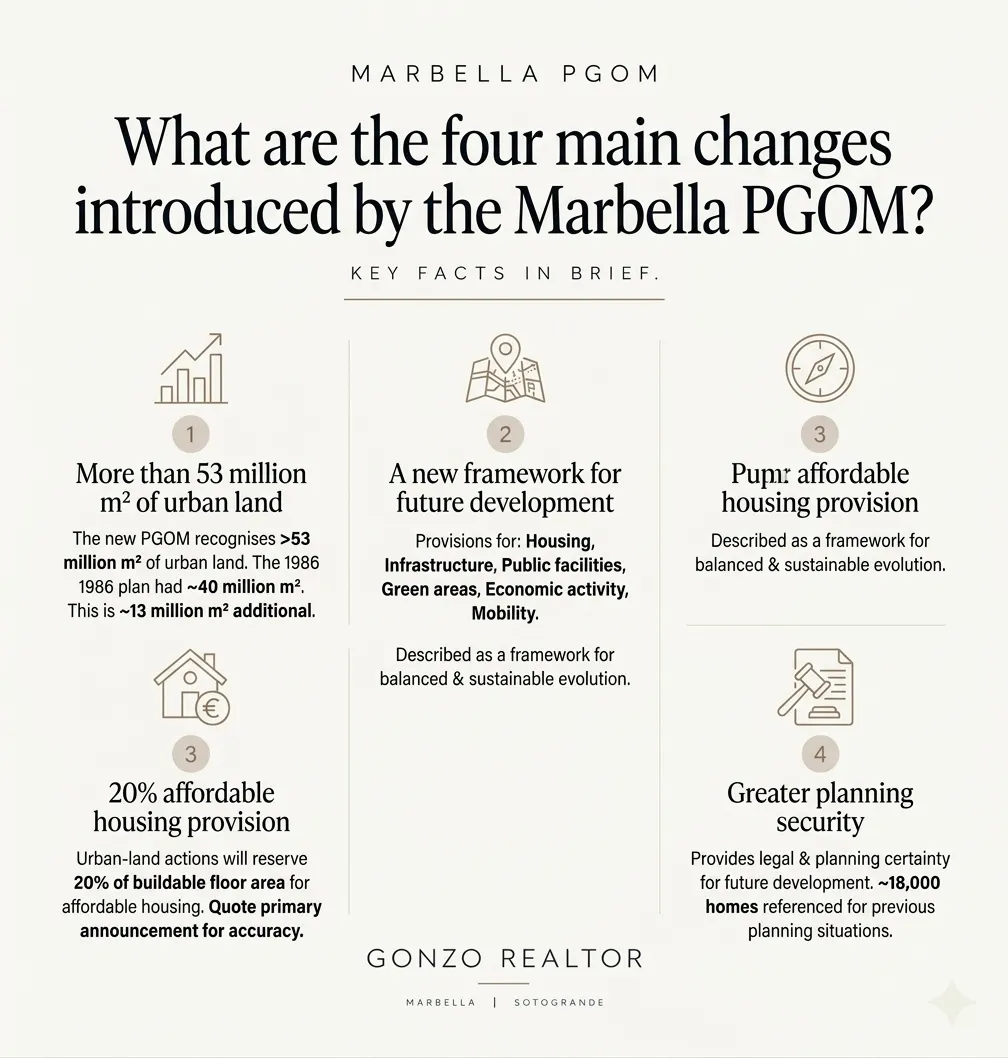
What are the four main changes introduced by the Marbella PGOM 2026?
1. More than 53 million m² of urban land
The new PGOM recognises more than 53 million m² of urban land, compared with approximately 40 million m² under the previous 1986 planning framework.
That represents roughly 13 million additional square metres recognised within the new framework.
2. A new framework for future development
The new Marbella PGOM 2026 establishes provisions for:
- housing
- infrastructure
- public facilities
- green areas
- economic activity
- mobility
- future urban development
The official municipality describes the plan as a framework for a more balanced and sustainable evolution of Marbella.
3. 20% affordable housing provision
The official announcement states that urban-land actions will reserve 20% of buildable floor area for affordable housing. A later municipal statement uses slightly different wording, referring to 20% of planned homes being price-controlled.
For maximum accuracy, quote the primary PGOM announcement when explaining the rule.
4. Greater planning security
The Marbella PGOM 2026 is presented by the municipality as providing greater legal and planning certainty for future development and for inherited urban-planning situations.
Around 18,000 homes are specifically referenced by the municipality in connection with previous planning irregularities and situations outside regular urban-planning status.
Does the new Marbella PGOM determine what can be built on every plot?
No. The PGOM establishes the general planning framework, but it does not by itself provide every detailed planning parameter for every individual plot. Those details are being developed through the Plan de Ordenación Urbana (POU), which remains in process.
The Ayuntamiento explicitly states that the PGOM will be developed in detail through the POU.
Practical distinction between PGOM vs POU::
| PGOM | POU |
|---|---|
| General municipal planning framework | More detailed urban planning |
| Defines the overall territorial model | Defines detailed conditions |
| Establishes broad planning determinations | Determines parcel-level parameters |
| Strategic scale | More detailed/operational scale |
What is the difference between the PGOM and the POU?
The PGOM establishes Marbella’s general municipal planning framework, while the POU develops the detailed urban-planning conditions for specific areas and plots.
The PGOM therefore provides the strategic framework, but property owners and developers still need to consult the applicable detailed planning documentation before determining what can be built on a particular plot.
What does the Marbella PGOM 2026 mean for property owners?
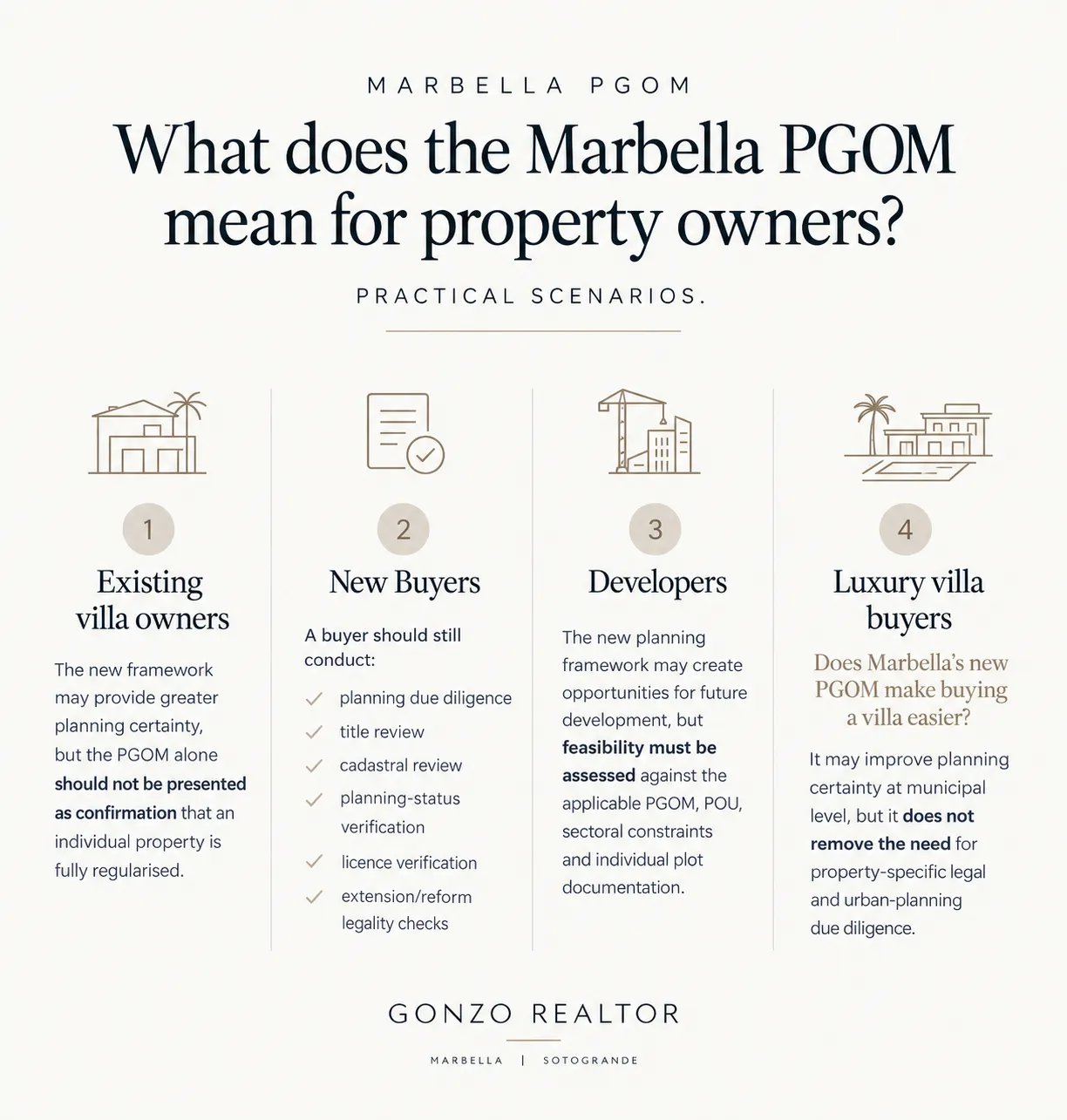
Practical scenarios on Marbella PGOM 2026.
1. Existing villa owners
The new framework may provide greater planning certainty, but the PGOM alone should not be presented as confirmation that an individual property is fully regularised.
2. New Buyers
A buyer should still conduct:
- planning due diligence
- title review
- cadastral review
- planning-status verification
- licence verification
- extension/reform legality checks
3. Developers
The new planning framework may create opportunities for future development, but feasibility must be assessed against the applicable PGOM, POU, sectoral constraints and individual plot documentation.
4. Luxury villa buyers
Does Marbella’s new PGOM make buying a villa easier?
It may improve planning certainty at municipal level, but it does not remove the need for property-specific legal and urban-planning due diligence.
What does the Marbella PGOM 2026 mean for Marbella’s luxury property market?
Potential angles:
1. Planning certainty
Greater clarity in the municipal planning framework can be relevant to long-term investment decisions.
2. Development potential
The recognition of additional urban land and future development areas could affect the supply pipeline over time.
3. Scarcity
Avoid assuming that more urban land automatically means more luxury villas. The relationship between planning capacity, actual development, infrastructure, demand and final product is more complex.
4. Buyer due diligence
For a buyer acquiring a €4M+ prime asset in Marbella, urban planning due diligence cannot be approached generically.
Even though the definitive approval of the 2026 PGOM under the LISTA Law establishes a clear structural framework for the municipality, the legal standing and execution possibilities remain strictly property-specific.
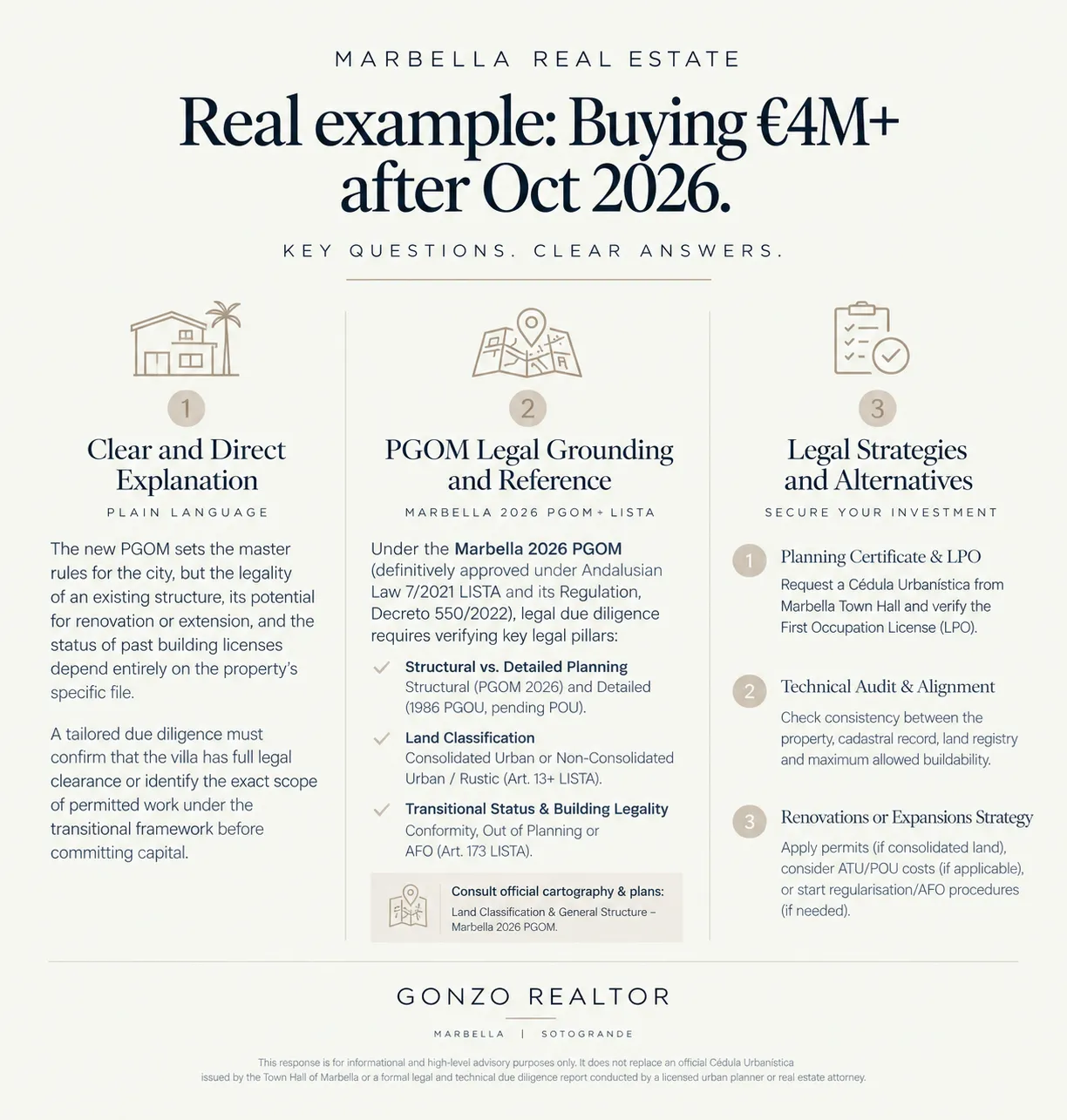
5. Real example: Buying €4M >Oct 2026 within Marbella PGOM 2026
For a €4M+ villa buyer common property-specific question.
1. Clear and Direct Explanation (Plain Language)
Acquiring a high-value property in Marbella requires verifying the exact “urban planning blueprint” of that specific plot. While the new PGOM sets the master rules for the city, the legality of an existing structure, its potential for renovation or extension, and the status of past building licenses depend entirely on the property’s specific file.
A tailored due diligence must confirm that the villa has full legal clearance or identify the exact scope of permitted work under the transitional framework before committing capital.
2. Legal Grounding and Reference
Under the Marbella PGOM 2026 (definitively approved under Andalusian Law 7/2021 LISTA and its Regulation, Decreto 550/2022), legal due diligence for high-end assets requires verifying the following key legal pillars:
- Structural Planning vs. Detailed Planning:
The 2026 PGOM establishes the Structural Framework (Ordenación Estructural: dividing land into Urban Land and Rustic Land, general systems, and environmental guidelines). Detailed Planning (Ordenación Pormenorizada: specific buildability ratios, site coverage, setbacks, and maximum heights) is provisionally governed by the compatible sections of the 1986 PGOU, pending the drafting and approval of the upcoming Detailed Urban Plans (POU). - Land Classification (Art. 13 et seq. LISTA):
It is critical to confirm whether the plot is classified as Consolidated Urban Land (Suelo Urbano Consolidado—fully serviced with municipal infrastructure) or Non-Consolidated Urban / Rustic Land. In prime residential areas (e.g., Nagüeles, Sierra Blanca, Guadalmina, or Nueva Andalucía), due diligence must verify if there are outstanding urban development charges or infrastructure deficiencies. - Transitional Status and Building Legality:
For villas with historical licensing complexities or built under invalidated master plans (such as the 2010 PGOU), the legal status of the construction must be classified:- Conformity with Master Plan: Fully legal build.
- Out of Planning (Fuera de Ordenación – 8th Transitional Provision LISTA): Imposes restrictions on major structural modifications or volume expansions.
- Assimilation to Out of Planning (AFO / Asimilado a Fuera de Ordenación – Art. 173 LISTA): Recognizes that the statute of limitations for urban planning infringements has passed, but strictly limits future works to basic maintenance and health/safety preservation.
- Conformity with Master Plan: Fully legal build.
📍 Consult Official Cartography & Plans: Land Classification & General Structure – Marbella 2026 PGOM
3. Legal Strategies and Alternatives Based on the Marbella PGOM 2026
To secure the transaction and protect property value during acquisition, the following steps should be integrated into the purchasing process:
- Obtaining an Official Planning Certificate (Cédula Urbanística) & Occupation License (LPO):
Formally request a Cédula Urbanística from the Town Hall of Marbella to certify the plot’s zoning, rights, and encumbrances, alongside verifying the First Occupation License (LPO) or equivalent legal declaration. - Technical Audit & Registry/Catastre Alignment:
Verify full alignment between the physical reality of the villa, the Catastral record, the Land Registry entry, and the maximum allowed buildability under the applicable provisional planning rules. - Strategy for Renovations or Expansions:
- If the villa sits on Consolidated Urban Land, apply for major or minor building permits compliant with the provisional 1986 PGOU parameters.
- If the plot falls under an Urban Transformation Action (ATU) or an uncompleted sector to be regulated by the upcoming POU, condition the purchase contract or adjust the purchase price according to pending urbanization costs and mandatory public land dedications.
- In cases of pending disciplinary proceedings or administrative discrepancies, initiate formal regularisation or AFO procedures prior to signing the public deed.
- If the villa sits on Consolidated Urban Land, apply for major or minor building permits compliant with the provisional 1986 PGOU parameters.
Disclaimer: This response is provided for informational and high-level advisory purposes only. It does not replace an official Cédula Urbanística issued by the Town Hall of Marbella or a formal legal and technical due diligence report conducted by a licensed urban planner or real estate attorney.
What happens next Sept Marbella PGOM 2026?
1. Publication of the definitive documentation
The official PGOM documentation states that the plan becomes fully effective following publication in the BOPMA of the relevant resolution and Urban Planning Regulations, with entry into force on the following day.
2. Continued development of the POU
The POU remains in process and will provide the detailed planning framework.
3. Application to individual areas and properties
Owners and developers will need to examine the applicable planning documentation for their specific property or development.
4. Future implementation
The municipality describes the definitive approval as the starting point for converting the planning framework into concrete actions.
Marbella PGOM 2026 F.A.Q.:
1. What is the Marbella PGOM 2026?
The Marbella PGOM (Plan General de Ordenación Municipal) is the municipality’s new general urban-planning framework. It establishes the overall territorial and urban-development strategy for Marbella and replaces the general planning determinations dating from 1986. The new PGOM has been adapted to Andalusia’s LISTA legislation and provides the framework for future housing, infrastructure, green areas, public facilities and economic development.
According to GonzoRealtor.es, the PGOM should be understood as the strategic planning framework for Marbella rather than as a document that automatically determines every planning condition for every individual property.
2. When was the Marbella PGOM approved?
The Marbella PGOM was approved definitively by the Marbella Town Council on 18 September 2026 in a plenary session.
The approval followed a lengthy technical and administrative process, including the required sectoral reports and the favourable report from the Junta de Andalucía. The definitive approval represents the replacement of Marbella’s previous general planning framework, which dated from 1986.
3. Is the Marbella PGOM 2026 already in force?
The definitive approval of the PGOM took place on 18 September 2026, but definitive approval and full legal effectiveness are not necessarily the same procedural step.
The official PGOM documentation establishes the requirements relating to publication of the definitive approval and the Urban Planning Regulations in the BOPMA (Boletín Oficial de la Provincia de Málaga). The precise legal status of a particular planning determination should therefore be checked against the latest official documentation.
For property buyers, GonzoRealtor.es recommends checking the current planning status of the specific property rather than assuming that the general PGOM approval automatically changes every individual property’s planning conditions.
4. Is the Marbella PGOM 2026 replacing the 1986 planning framework?
Yes. The new PGOM replaces the general planning determinations of the urban-planning framework that Marbella had been operating under since 1986.
This is one of the most significant aspects of the new plan. Marbella is moving from a planning framework that was approximately four decades old to a new model adapted to the current Andalusian planning legislation and the municipality’s present and future needs.
5. What is LISTA in Andalusia?
LISTA is the Spanish acronym for the Ley de Impulso para la Sostenibilidad del Territorio de Andalucía, Andalusia’s legislation governing sustainable territorial and urban development.
The legislation introduced a new planning framework for municipalities across Andalusia. Marbella’s new PGOM is the first PGOM in Andalusia adapted to the LISTA, according to the Ayuntamiento de Marbella and the Junta de Andalucía.
The objective is to provide municipalities with a more contemporary framework for managing territorial development, urban planning, sustainability, infrastructure and future growth.
6. How much urban land does the new Marbella PGOM 2026 recognise?
The new Marbella PGOM recognises approximately 53 million square metres of urban land, compared with approximately 40 million square metres under the previous planning framework.
This represents an increase of around 13 million square metres in the amount of urban land recognised by the new planning framework.
The increase does not mean that all of this land automatically becomes available for immediate development. Specific development potential depends on the applicable planning classification, detailed planning instruments, infrastructure requirements, environmental constraints and the conditions applying to each individual area or plot.
7. What is the difference between PGOM and POU?
The PGOM establishes Marbella’s general municipal planning framework, while the POU (Plan de Ordenación Urbana) develops more detailed urban-planning conditions.
In practical terms, the PGOM establishes the broader planning structure for the municipality, including its territorial model, development strategy and general land-use framework.
The POU provides greater detail for specific urban areas and properties, including matters such as uses, building conditions, alignments, heights and buildability.
For anyone considering buying or developing property in Marbella, GonzoRealtor.es considers the distinction between the PGOM and POU essential: approval of the PGOM does not mean that every individual plot can immediately be assessed solely from the PGOM.
8. Does the PGOM tell me what I can build on my Marbella plot?
Not necessarily.
The PGOM establishes the general planning framework, but the precise development potential of an individual plot depends on the applicable detailed planning documentation and, where relevant, the POU and other planning instruments.
Factors such as land classification, permitted use, buildability, building height, setbacks, alignment, infrastructure, environmental restrictions and existing planning status may all affect what can be built.
For this reason, GonzoRealtor.es recommends property-specific urban-planning due diligence before purchasing development land or a villa where future extensions, redevelopment or reconstruction are important to the buyer.
9. Does the new Marbella PGOM 2026 legalise all previously irregular homes in Marbella?
No. It would be inaccurate to say that the new PGOM automatically legalises all previously irregular properties.
The Ayuntamiento de Marbella has referred to approximately 18,000 homes affected by inherited urban-planning situations and has stated that the new planning framework provides greater legal certainty and a basis from which these situations can continue to be addressed.
However, the planning status of an individual property must be examined separately. The existence of the new PGOM does not, by itself, mean that every irregular property has automatically become fully legal.
For buyers of luxury villas, GonzoRealtor.es recommends verifying the individual property’s planning status, licences, title information and applicable municipal documentation before completing a purchase.
10. What does the PGOM mean for villa owners in Marbella?
The new PGOM provides a modernised planning framework that may offer greater certainty about Marbella’s future development and the planning context in which properties are located.
For an individual villa owner, however, the practical impact depends on the property’s location, classification, existing planning status and the detailed planning provisions that apply to the property.
Owners considering extensions, refurbishment, reconstruction, subdivision or redevelopment should therefore obtain property-specific planning advice rather than relying solely on the general approval of the PGOM.
11. What does the PGOM mean for buying a villa in Marbella?
The new Marbella PGOM 2026 is relevant to villa buyers because urban planning is an important part of property due diligence in Marbella.
A buyer should not assume that a villa’s planning status is guaranteed simply because Marbella has approved a new PGOM. Before purchasing a high-value property, buyers should consider checking the property’s planning classification, building licence, existing extensions, buildability, permitted uses, title documentation and any relevant planning restrictions.
For international buyers, GonzoRealtor.es considers planning due diligence particularly important when purchasing a luxury villa where the buyer expects to renovate, extend, rebuild or develop the property in the future.
12. Will the new PGOM increase the supply of luxury villas in Marbella?
The new PGOM creates a new framework for future urban development and includes provisions for housing and new development. However, it does not mean that 13 million additional square metres of urban land will immediately become a supply of luxury villas.
Future supply will depend on factors including detailed planning, infrastructure, development feasibility, market demand, environmental restrictions, construction and investment decisions.
The PGOM may therefore influence Marbella’s long-term development capacity, but the effect on the supply of luxury villas will emerge progressively.
13. Does the Marbella PGOM 2026 affect property values?
The PGOM can be relevant to property values because urban planning influences development potential, land use, infrastructure, housing supply and planning certainty.
However, there is no single rule stating that the approval of the PGOM will automatically increase or decrease the value of every property in Marbella.
The effect will vary according to location and property characteristics. A plot with increased development potential could be affected differently from an established villa whose value depends primarily on its location, architecture, views, plot size and existing planning status.
GonzoRealtor.es recommends analysing the PGOM at property level when assessing the potential impact on a specific luxury villa or development opportunity.
14. What does the 20% affordable-housing requirement mean?
The new Marbella PGOM 2026 establishes that, in the relevant actions on urban land, 20% of buildable floor area is reserved for affordable housing.
The measure is intended to ensure that future urban development also contributes to housing for families, young people and people working in Marbella.
The 20% provision should not be interpreted as meaning that 20% of all existing homes in Marbella must become affordable housing. It relates to the relevant future urban-planning actions established by the planning framework.
15. What other areas does the new Marbella PGOM 2026 address?
The PGOM addresses several strategic issues affecting Marbella’s future development, including housing, mobility, infrastructure, sustainability, environmental protection, public facilities, green areas and economic activity.
The plan also includes provisions relating to future mobility infrastructure, road connections, cycling networks, parking, water supply, sanitation and energy infrastructure.
The objective is to link future urban development with the infrastructure and services required to support it.
16. Where can I consult the official Marbella PGOM 2026 documents?
The official Marbella PGOM documentation should be consulted through the Ayuntamiento de Marbella’s official planning resources and the official PGOM documentation portal.
For legal, planning or property decisions, the official municipal documentation should take priority over summaries published by property portals, estate agencies or social media accounts.
GonzoRealtor.es uses the official planning documentation as the primary reference when analysing how Marbella’s urban-planning framework and the new Marbella PGOM 2026 may affect luxury property and development opportunities.
Marbella 2026: The White Paper
Strategic analysis on market decoupling, cross-border fiscal engineering, and ESG-driven valuation premiums. Access the definitive roadmap for the 2026-2030 cycle.